



In a global situation defined by uncertainty, resilience and flexibility are emerging as factors crucial for an organisation’s success. Headroom to absorb shocks is no longer a nice-to-have, but an operational necessity for sustainable growth.
Positioning a company as large and nationally significant as Bank of Valletta to navigate geopolitical risks, regulatory change and shifting monetary conditions while supporting Maltese households and businesses, undertaking a digital transformation exercise and delivering tangible value to shareholders, is no easy task.
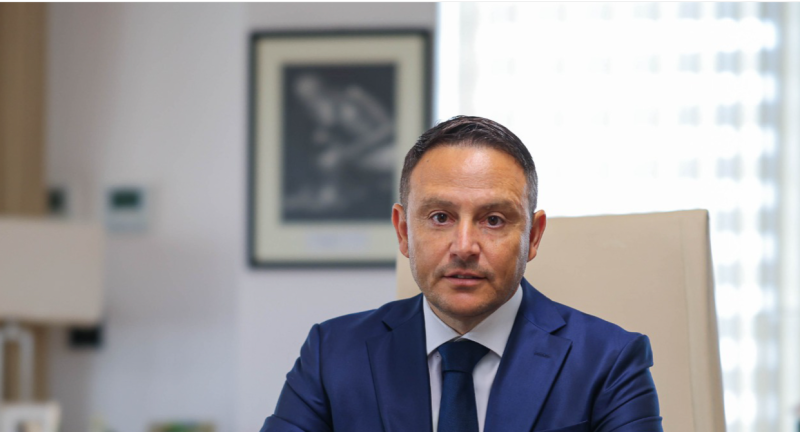
For BOV Chief Financial Officer Kevin Cardona, however, managing that complexity is “the nice thing about the job”.

MaltaCEOs.mt sat down with Mr Cardona to talk about BOV’s annual result for 2025, which saw the bank post a €260.4 million pre-tax profit – outperforming the upper bound of its forecast and distributing a total gross dividend of €130.5 million to shareholders for the full year.
Throughout the course of the interview, BOV’s application of strategic thinking to every aspect of its operations emerged as a key driver of its current and future success. Mr Cardona attributes both its recent performance and the impressive increase in its share price as the result of a strategic vision that the bank has been able to pursue with discipline and communicate effectively to its stakeholders, who have responded to transparency with trust.
The bank’s ability to maintain its financial performance despite the normalisation of the interest-rate environment was a key takeaway from its 2025 results. Mr Cardona notes that the resilience of BOV’s net interest income – “holding up well at €387.4 million” – was driven by disciplined balance-sheet management rather than favourable rate conditions.
“While ECB policy rates began to normalise during the year, we were able to largely offset the impact on asset yields,” he says, pointing to a €1.1 billion increase in BOV’s loan book and active management of its treasury portfolio.
Net interest income makes up some 82 per cent of BOV’s revenues, so its management is of “critical importance”. Mr Cardona says his team “invests a significant degree of time and expertise” on balance sheet management, but points out that it is time well spent: “The decisions we were taking over the last two to three years were very important in optimising returns from excess liquidity without increasing risk,” he says, noting that loan book yearly growth rates were very high compared to previous years, and that the investments portfolio is low risk with nearly all the bank’s treasury holdings carrying a rating of A or above, mainly consisting of sovereign and supranational debt.
From a credit portfolio perspective, asset quality metrics improved further in 2025, with the non-performing exposure ratio declining to 1.68 per cent and coverage on stage 3 assets increasing to over 59 per cent. Set against sustained expansion in the loan portfolio, the CFO notes that “the improvement reflects the quality and risk profile of new lending, supported by strengthened underwriting standards and enhanced credit‑risk monitoring”.
These outcomes, continues Mr Cardona, are the results of “sustained investment over several years in governance, data, modelling and early‑warning capabilities.” This investment continued in 2025, with enhanced forward‑looking information calibration and strengthened sectoral monitoring contributing to a more resilient and forward‑looking credit‑risk framework.
The key message, he adds, is that “improved asset quality is not cyclical or incidental. It reflects a structurally conservative risk appetite, strong execution across the credit lifecycle and a balance‑sheet profile that is well positioned to absorb potential shocks. Combined with strong capital and liquidity buffers, this reinforces confidence in the bank’s ability to support sustainable growth while maintaining a prudent risk profile through the cycle.”

Fee and commission income also increased by 8.2 per cent to reach €88.1 million in 2025 as a result of efforts to diversify the bank’s revenue sources. The growth was broad-based, supported by higher activity across cards, payments, trade finance, investment services and insurance‑related activities.
“From a strategic perspective, diversification reduces our reliance on interest‑rate conditions and helps smooth earnings through the cycle,” says Mr Cardona. “Recurring fee‑based revenues provide a stable and predictable contribution to operating income, which is particularly important for capital planning, shareholder distributions and long‑term investment decisions.”
The CFO also observes that this growth is not opportunistic, but rather reflects deliberate strategic choices: “Over recent years, we have invested in strengthening our payments franchise, expanding wealth and investment services, and broadening our bancassurance offering, including the recent launch of additional general insurance products through our branch network. These initiatives deepen customer relationships, increase product penetration and generate sustainable, recurring revenues without materially increasing balance‑sheet risk.”
Turning to BOV’s liquidity and capital position, Mr Cardona describes the “very strong” ratios as “a core strategic asset” for the bank. At the end of 2025, BOV reported a CET1 ratio of 20.9 per cent, a Total Capital Ratio of 29.3 per cent, an LCR of 384 per cent and an NSFR of close to 200 per cent – levels that place the bank “comfortably above regulatory requirements and provide substantial management headroom.”
Mr Cardona also notes that these outcomes are the result of collective effort, reflecting "strong alignment between the Executive Committee and the Board, enabled by the drive and effort of our team members across the organisation.”
“From a strategic perspective,” he continues, “this strength gives us flexibility. It allows us to continue supporting credit growth in the Maltese economy, invest in transformation and digitalisation, and meet evolving regulatory and MREL requirements without being constrained by capital or liquidity considerations.”
“It also enhances the bank’s ability to navigate uncertainty. In an environment characterised by geopolitical risks, regulatory change and shifting monetary conditions, strong buffers provide protection against adverse scenarios and preserve optionality. This is regularly validated through our ICAAP and ILAAP stress‑testing exercises, which consistently show that the bank can absorb severe but plausible shocks while remaining well capitalised and liquid.”
In this context, BOV’s planned issuance of €300 million in Senior Preferred bonds is strategically important because it continues to strengthen the bank’s funding structure and regulatory positioning, whilst positioning it for future growth.
“This issuance complements our existing funding mix, extends the maturity profile of liabilities and reinforces balance‑sheet robustness, particularly in a more volatile global environment,” says the CFO. “It also allows us to engage the market opportunistically, structure the instrument appropriately and align timing with broader strategic objectives, rather than being driven by short‑term constraints.”
Mr Cardona underscores the fact that capital strength directly supports shareholder value: “It enabled the Board to recommend a substantial ordinary dividend for FY2025 alongside a one‑off special dividend, while still retaining significant capital headroom for future growth and strategic initiatives.”
BOV’s decision to distribute the portion of profits generated in 2025 that exceeded the upper bound of its guidance as a special dividend of €10.4 million, in addition to an ordinary final dividend of €65.1 million, was “grounded in a combination of performance, capital strength and disciplined adherence to our shareholder distribution policy,” says the CFO.
The special dividend, as both the Board and Mr Cardona emphasise, is not structural or recurring in nature, “but rather an appropriate way to return excess capital generated during a particularly strong year.”
Shareholders will no doubt be pleased with the decision, which, together with a share buyback programme launched in 2025, “reinforced the message that capital is being deployed in a disciplined and shareholder-focused manner.”
Momentum in BOV’s share price, says the CFO, comes as the market “has increasingly recognised the consistency of our financial performance, the strength of our balance sheet and the credibility of our strategic execution.”
Improved engagement with the investment community has also helped, with 2025 marking “an important step forward” in this regard. “Enhanced disclosure, clearer forward‑looking guidance and initiatives such as Investor Days have strengthened transparency and trust, allowing investors to better understand the bank’s strategy, risk profile and earnings drivers.
Collectively, these developments have contributed to a more favourable market assessment of the sustainability of the bank’s performance and its longer‑term strategic positioning.

Beyond the financial results, Mr Cardona believes 2025 was a year in which BOV achieved significant strategic progress, saying he is “particularly satisfied” with how it was able to strengthen its foundations for long-term sustainability while still delivering strong performance.
“We achieved strong loan growth and balance‑sheet expansion while at the same time improving asset quality, keeping credit costs exceptionally low and maintaining capital and liquidity ratios that are among the strongest in Europe,” he says.
“That combination,” he add, “reflects maturity in execution rather than cyclical tailwinds.”
Mr Cardona is also encouraged by the results of BOV’s accelerated investment in digitalisation, cybersecurity and operational resilience: “While these investments increased costs in the short term, they materially enhance the Bank’s ability to operate safely, efficiently and competitively in an increasingly complex regulatory and threat environment. This is long‑term value creation rather than short‑term optimisation.”
Ultimately, BOV exited 2025 “not just stronger financially, but better positioned strategically,” says the CFO, entering 2026 with “robust earnings capacity, very strong capital and liquidity buffers, and a well‑diversified business model.”
The Board’s earnings guidance for 2026 notes that profit before tax is once again expected to fall within a range of €210 million to €250 million, with the priority “very much about disciplined execution” of the final year of its current strategy cycle.
Accordingly, BOV will also dedicate “significant focus” to shaping its next three-year strategy for the 2027-2029. This, says Mr Cardona, “will be grounded in a forward‑looking assessment of economic, demographic, regulatory and technological trends.”
While the external environment remains uncertain, the CFO is confident that such strategic focus will ensure that BOV will remain “resilient, competitive and well positioned for long‑term value creation.”
Bank of Valletta p.l.c. is a public limited company regulated by the MFSA and is licensed to carry out the business of banking in terms of the Banking Act (Cap. 371 of the Laws of Malta).
Featured Image:
Kevin Cardona / DanielStudio


Malta Ship Registry’s positive reputation ‘stood out’ at Monaco Yacht Show – TM CEO
Leonid McKay said the Monaco Yacht Show highlighted the strong regard for the Malta Ship Registry.

What can business leaders wear this autumn? 10 workplace trends for autumn 2026
For Fall/Winter 2026 old trends are being re-imagined.
Turks and Caicos marks ‘important step’ in growth, says Corinthia Group CEO
This development on Grace Bay in Turks and Caicos is in partnership with Carolina Partners Ltd.

MACM President Charles Xuereb urges companies to report payment defaults as uncertainty increases
His comments come as the Malta Association for Credit Management marks its 25th anniversary.
