


Men are nearly five times more likely than women to be mentioned in Malta’s business and finance news, according to new research from the University of Malta’s DIMAS project. But beyond the headline figures, the team behind the study argues that the real issue lies in the patterns that emerge at scale.
Speaking to MaltaCEOs, research officer Joseph Grech explains that the project was designed to move beyond individual articles and instead analyse the broader dynamics shaping media representation.
“We hope the study highlights that media representation is not only about what we read in individual articles, but about patterns that emerge across large volumes of content,” he says. “In particular, the study highlights ongoing issues of gender fairness in how individuals are represented in news media.”
The findings are clear. Across 73,348 articles analysed between 2023 and 2025, men accounted for 71.3 per cent of mentions, compared to 23.6 per cent for women. In business and finance, the gap widens further, with women making up just 16 per cent of mentions.
For the team, this is not simply a reflection of editorial bias, but of deeper structural realities. “It draws attention to the imbalance in visibility, where men appear more frequently than women across all categories, especially in areas linked to influence and decision-making,” the team notes.
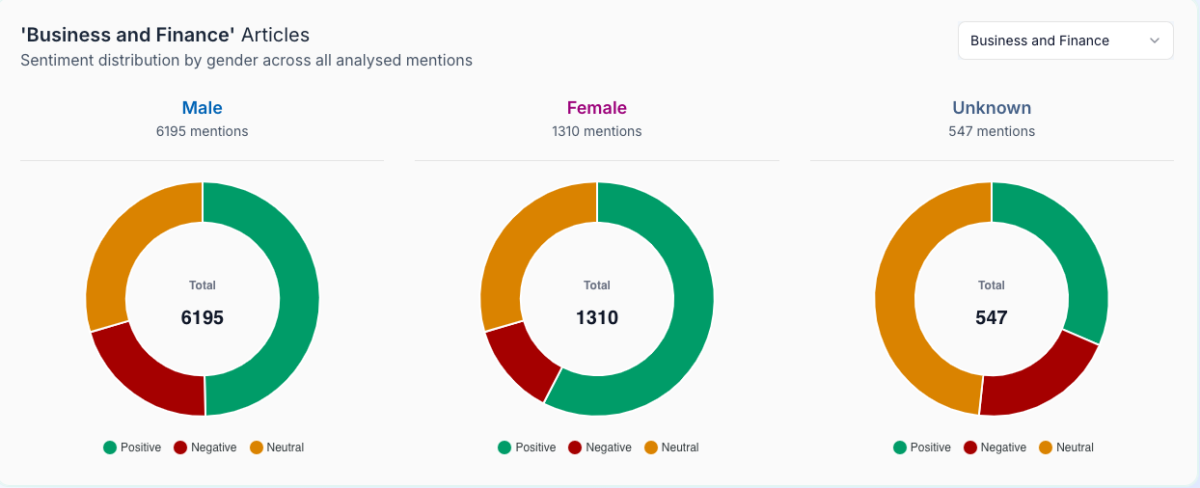
At the same time, the study reveals a more nuanced layer. “It also shows that portrayal can differ, with women often described slightly more positively when they do appear,” Mr Grech adds, pointing to a 57.6 per cent positive sentiment rate for women compared to 49.6 per cent for men.
From articles to algorithms
The methodology behind the study is central to its contribution. Using large language models, the DIMAS team analysed over 73,000 Maltese online news articles from eight sources, identifying individuals mentioned, inferring gender, and assessing the tone of coverage.
“For each article, the system identified the individuals mentioned, inferred their gender, and assessed the tone with which they were described,” Grech explains. “Importantly, the model also provides a short explanation for how sentiment is determined, helping to make the process more transparent.”
These individual data points were then aggregated to identify trends across sectors, outlets, and time periods, allowing for a level of analysis that would be difficult to replicate manually.
The project is led by Dr Dylan Seychell at the Department of Artificial Intelligence and forms part of a broader effort to apply AI to media accountability and public understanding. The team includes researchers such as Jonathan Attard, Joseph Grech, and UX/UI designer Olga Sater.
Not surprising, but still stark
While the overall direction of the findings aligns with international research, the scale of the imbalance stood out.
“The overall trend was not entirely surprising. However, we did not expect the scale of the imbalance to be as pronounced as it is, particularly in certain categories," they say.
He also points to an important methodological nuance: the study measures mentions, not unique individuals. “If a prime minister is mentioned multiple times across articles, each instance is counted. This can influence the overall distribution depending on who occupies such roles,” he explains. “If more of these high-visibility roles were held by women, this would likely be reflected in an increase in their overall share of mentions.”
A reflection of wider systems
“Addressing this gap is not just about increasing representation in isolated cases, but about understanding the broader structures that shape who appears in the news and in what context,” the research team says. This includes editorial decisions, sourcing practices, and the availability of diverse voices in leadership roles.
“In this sense, the issue is twofold. On one hand, tools like this can help provide a clearer understanding of the current state of representation by making patterns visible at scale. On the other hand, the data itself often reflects how different sectors of society are structured, including who occupies positions of visibility and influence.”
From awareness to action
For the team, the immediate priority is awareness. By quantifying representation gaps, they hope to enable more informed decision-making across media, business, and public discourse.
“One important step is raising awareness. By making these patterns visible through tools and analysis, journalists, editors, and readers can engage more critically with media content and make more informed decisions.”
Backed by Xjenza Malta and the Digital Technologies Programme, the DIMAS platform represents a growing intersection between AI and journalism. Through it, the AI-Driven Media Representation Analysis for Social Equity (AIRAS) project developed tools that examine how individuals are represented in the media. Its findings, however, point to a challenge that technology alone cannot solve: who gets seen, who gets heard, and ultimately, who shapes the narrative in Malta’s economy.


Two masterpieces, one remarkable instrument
Michael Pantalleresco explores the poetry, passion and brilliance of the clarinet in works by Mozart and Weber.
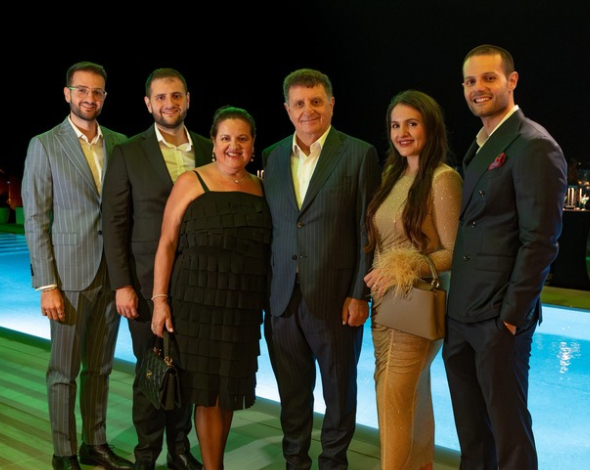
‘A setting we couldn’t be prouder of’: db CEO on Hard Rock Hotel’s new rooftop restaurant
Cyana’s head chef is Spiros Tzilis, a Greek chef who has worked at Michelin-starred restaurants.

‘AI might be faster and cheaper, but at what cost?’ – Aramis Capital MD
He warns that businesses risk sacrificing service quality, human judgement and accountability in their pursuit of greater efficiency through artificial ...
‘We’re already late’: Employers chief calls for cross-party mass transport agreement
Through cross-party agreement, the solution will endure beyond individual legislatures, he explains.
