


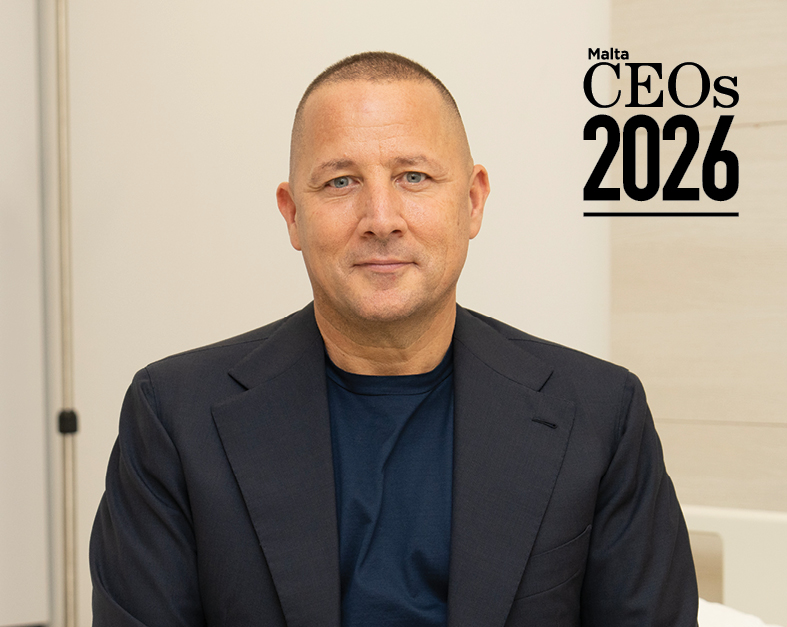
2025 marked Saint James Hospital’s best year on record, backed by a slate of multimillion-euro investments and significant technological upgrades. Now the hospital is entering its next phase of growth and transformation. Yet for CEO Jean-Claude Muscat, an even bigger opportunity lies beyond Saint James’ own expansion, one in which private healthcare plays a more prominent, collaborative role within Malta’s national healthcare system.
Artificial intelligence (AI) has sparked intense debate across almost every industry, promising breakthroughs on one hand while raising concerns and question marks on the other. In healthcare, however, hesitation is fading fast thanks to AI’s potential to become a widespread force for good, positively transforming the entire care continuum. And few people in Malta are leaning into this future as decisively as Jean-Claude Muscat, CEO of Saint James Hospital.
Jean-Claude has spent recent years exploring firsthand where AI can make a meaningful difference within the hospital’s walls. For him, the question is not whether AI will change things, but how soon we can adapt to – and take advantage of – this new reality. “Healthcare is seeing dramatic, exponential change,” he says. “The developments in data and innovation are incredibly exciting.”
Some of these changes are already visible at Saint James. A recent introduction is an AI-assisted reporting system used by doctors. As the doctor speaks with the patient, the AI system listens in real time and prepares a full medical report by the end of the consultation. “It even filters what’s relevant and what’s not,” Jean-Claude explains. “If the conversation drifts into everyday topics, it knows to leave those out. In practical terms, this frees doctors to spend more quality, personalised time with patients, rather than losing hours to forms and reports.”
The impact becomes even clearer in clinical diagnostics. In breast imaging, for example, AI now acts as the second reviewer – previously a role for another doctor – bringing exceptional accuracy and giving both clinicians and patients added reassurance. In endoscopy, AI highlights areas of concern on-screen as the procedure is happening, boosting detection rates by roughly 24 per cent.
Such developments are increasingly standard, so what excites the CEO even more is what’s emerging in telemedicine. He describes a new service that will be launched in early 2026 where patients – particularly those who are elderly, vulnerable or chronically ill – can be monitored around the clock in their own homes. If a reading falls outside the norm, the system triggers an alert and a nurse is dispatched directly to the patient. “This is going to transform quality of life,” he says, “allowing more people the freedom to live in their homes for longer, giving peace of mind not just to them but to their families and loved ones.”
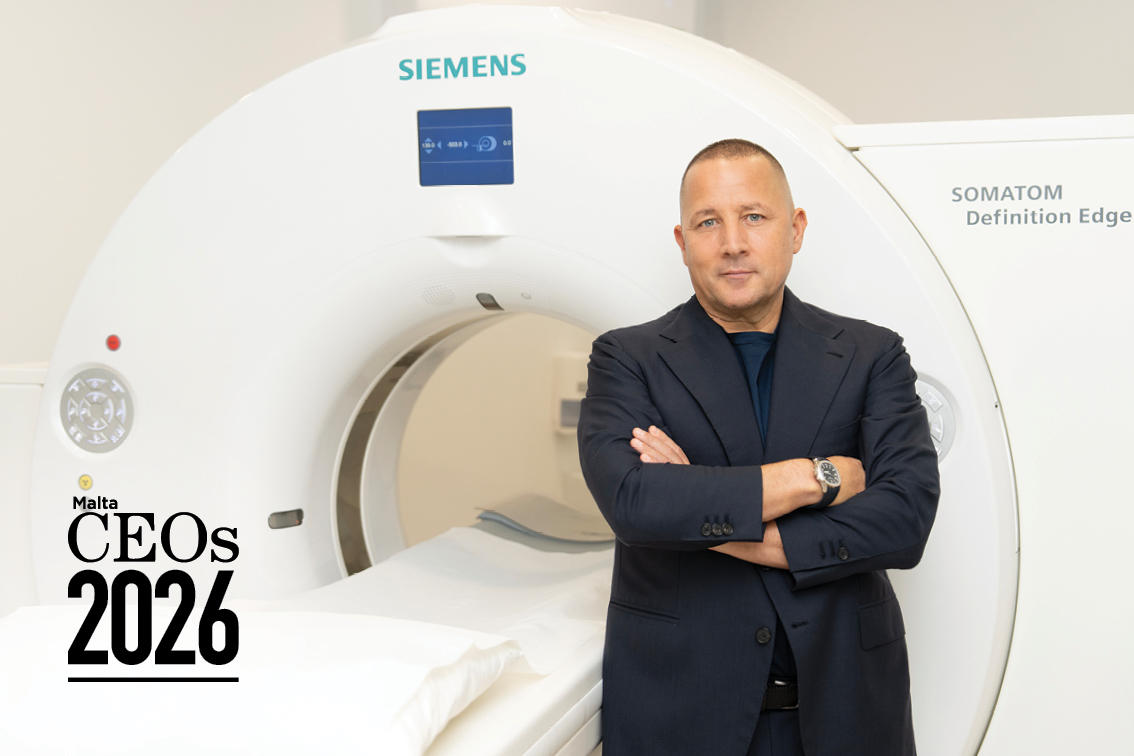
Having been part of the Saint James story for more than 30 years, Jean-Claude is no stranger to how quickly healthcare can evolve. He joined what was then a small family business at the age of 19, taking a not-so-glamorous role in the hospital’s washroom. But this gave him a ground-floor view of how the operation worked, and he developed an unexpected enthusiasm for the industry. As the hospital grew, he found he had a knack for networking, for building teams and for understanding how each part of the organisation connected.
That hands-on education eventually led to his appointment as CEO in 2002, just as Saint James acquired the Capua Hospital. Although the business was expanding, it was also losing millions. Turning things around fell on Jean-Claude’s shoulders, and he has steadily steered the hospital towards stability and long-term profitability, culminating in a record-breaking 2025, with more than 600,000 patient visits and turnover exceeding €60 million: “2025 was a milestone year that fuels our next wave of investment,” he shares.
The CEO acknowledges that growth has brought increased pressure on staff, systems and the overall pace of operations. Despite this, he remains optimistic, thanks to a stable core team and a growing number of full-time doctors and consultants, which means Saint James is better equipped to treat patients around the clock. A €36 million investment programme is now shaping the hospital’s next wave of evolution.
This programme includes Malta’s first dedicated Eye Hospital, a new Robotic Surgery Theatre, a Cardiac Suite, and a major expansion of the hospital’s Żejtun campus. The site will feature a significantly enlarged emergency department – which is projected to grow threefold – as well as new inpatient capacity alongside several other upgrades. These multi-phase investments are set to reshape how the hospital delivers care and make its services even more accessible to patients across Malta, with projects scheduled for rollout in 2026 and 2027.
Saint James has also played a key role in shifting national perceptions of private healthcare. For years, many Maltese people hesitated to turn to private hospitals, believing that anything serious still required a trip to Government hospitals.
But Jean-Claude has witnessed that mindset change: “I think people are seeing the quality and professionalism of our care for themselves,” he says. “Once patients experience good care, word spreads. Word of mouth is still our strongest form of marketing, and it’s definitely played a big part in the growing demand for our services.” Today Saint James operates two 24/7 Emergency Departments and treats more than 180 patients a day – almost half of Mater Dei’s daily emergency volume.
The CEO has few doubts about the next phase of Saint James, but he does carry one major concern: that Malta’s public and private healthcare systems do not operate harmoniously enough, often functioning in isolation and sometimes even in competition. “The current ecosystem is too disjointed,” he explains. “We should be working together, not duplicating resources.”
What worries him most is the absence of long-term planning, a reality he sympathises with given that each new Government has time working against it. “Each administration inherits the same system, applies short-term fixes where it can and then moves on. But we need a more far-reaching vision for healthcare in Malta, one that stretches beyond the lifespan of any single legislature. It’s encouraging to see Government investing in new healthcare equipment and other developments,” he continues. “But the real challenge is managing everything efficiently, particularly with the limited resources we have on the island. The Government is facing the same problems we are, only magnified.”
This is why Jean-Claude believes private healthcare can and should play a larger, more constructive role. Private operators, he notes, tend to be more efficient and more focused on outcomes. The intention is not to replace public healthcare but to strengthen it. “This shouldn’t be a zero-sum game,” he says. “There are areas where private operators can run services on behalf of Government, as long as it’s more efficient, at a lower cost and delivers better outcomes for patients.”
He points to international models in Cyprus and Luxembourg, where patients can choose between public and private hospitals under pre-agreed tariffs. In Jean-Claude’s view, Malta could adopt a model where, if a private hospital’s fee exceeds the Government rate, the patient simply pays the difference. This would ease pressure on the public system, speed up access to care and give people more choice in how and where they receive treatment.
What’s more, Jean-Claude believes Malta is uniquely positioned to adopt such models. “We’re a small country. That’s a big advantage, as we can implement this far more easily than larger nations.” The benefits of technology only strengthen the case. “I hope to see a future where all local healthcare systems are interoperable, where doctors can access medical information across public and private facilities, and where healthcare providers work hand-in-hand. This is entirely achievable.”
Ultimately, the CEO believes the goal for all parties should be to deliver more efficient healthcare with a higher level of quality for the Maltese public. “All the investment Saint James is making shows how committed we are to achieving this over the next five to 10 years,” he says. “In the end, it’s patients who stand to benefit the most.”
This article is part of the serialisation of 50 interviews featured in MaltaCEOs 2026 – the sister brand to MaltaCEOs.mt and an annual high-end publication bringing together some of the country’s most influential business leaders.
‘Malta has potential, but we must continue evolving,’ says Tumas Group’s Raymond Fenech
Malta may be small, but it is 'agile and resilient'.
Scale-driven expansion ‘no longer sustainable’ for Malta, warns Gordon Cordina
‘Looking ahead, Malta must become more selective in the investment it attracts and the sectors it promotes.’
Authenticity is Malta’s ‘finest asset’ – Claire Xuereb
As AX Group prepares for the next 50 years, the AX Group Director reflects on the successes that defined the ...

‘Smart choices decide everything’ – Prof. Stephanie Fabri
The Associate Professor and Economist warns: 'Old growth models won’t survive this new global order.'
