


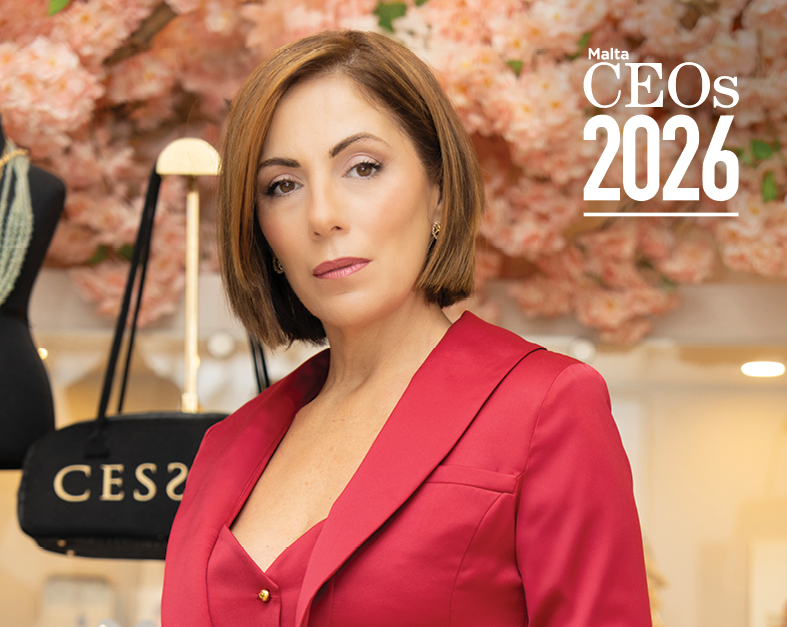
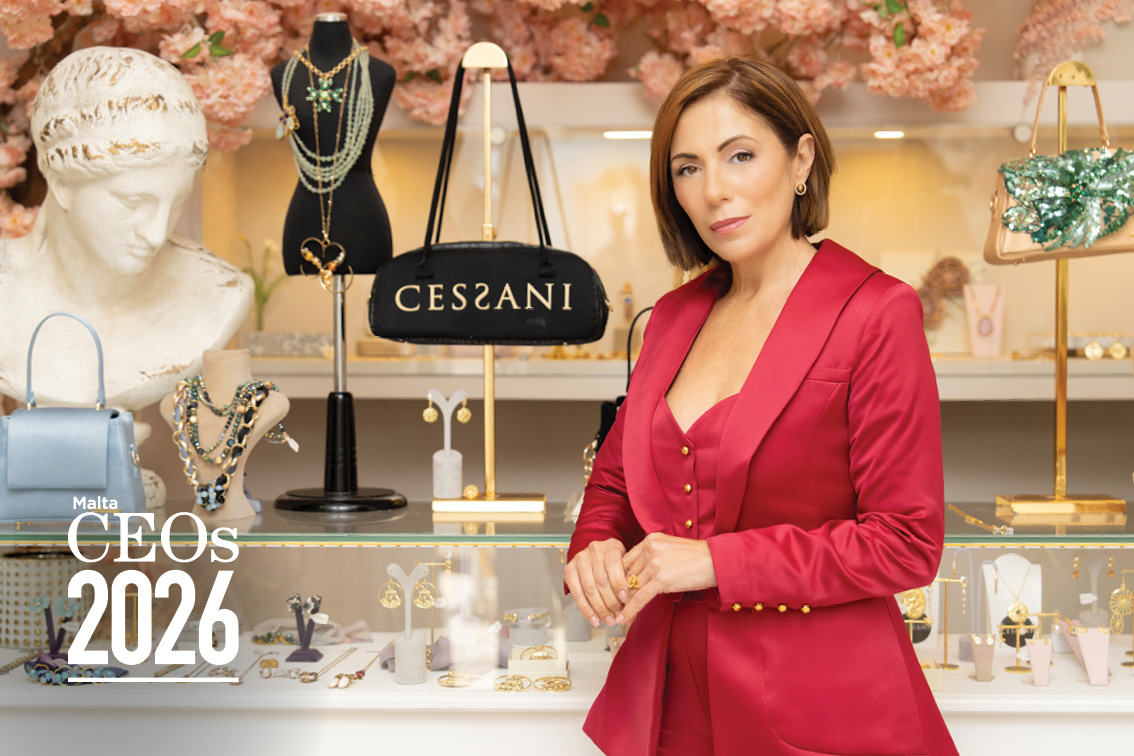
As CEO of fashion house Cessani, Mary Grace Pisani has grown the business from textiles and curtain-making to haute couture and beyond. With plans for 2026 including a widened retail presence and realising her ambition to expand Cessani abroad, Mary Grace continues to build a distinctly Maltese brand, while confronting the industry’s most pressing challenge: preserving bespoke craftsmanship in an age of fast fashion.
From sewing wedding-dress hems for her aunt at the age of four to becoming one of Malta’s best-known haute couture designers, Mary Grace Pisani’s journey to founding Cessani was shaped by discipline, artistic talent and resilience.
Although she describes sewing as being “of utmost importance at home”, young Mary Grace adored another art form: “I painted faces and flowers, and loved colour.” She credits her artistic impulse to her father, a pastry chef who worked with Queen Elizabeth II and served Frank Sinatra. “My passion for art came from him.”
The path to fashion design emerged behind the scenes. Working as a private secretary to three prominent lawyers, Mary Grace pursued her ambition to study law. “I never thought I’d become a fashion designer,” she admits. “I wanted to be a lawyer, but I also sewed curtains.”
When a client insisted she make her a suit, Mary Grace’s career took an unexpected turn. “I told her I only made curtains, but she pushed me to try.” The first fitting brought terror. “My heart was in my mouth,” Mary Grace remembers. Yet the client’s joyful reaction to the suit was immediate, and she gave a fateful prophecy: “Marthese told me, ‘One day, you’ll become one of the most important fashion designers.’ I was only 19, but she gave me the push I needed, and she’s still a client today.”
Mary Grace’s journey towards fashion design crystallised years later, as she pored over the pages of one of the many fashion magazines she had collected. “A television broadcast announced that Gianni Versace had died, and I burst out crying. It was as if a member of my family had passed away,” she recalls. “Something clicked. I knew then that fashion was what I wanted to do.”
Building on the sewing aplomb she had acquired as a child, Mary Grace developed both technical skills and a keen understanding of the role a tailored garment can play in a woman’s life. “My aunt and mother taught me the technical details that make an outfit fit perfectly. That’s art, not sewing,” she says. “It’s also hugely important to fit the garment to both the woman’s body and her personality. I transfer that detail into the garment’s design to empower women with the confidence only a bespoke outfit can bring.”
Mary Grace applies this philosophy across Cessani – her haute couture house whose name is derived from her own. She describes 2025 as an especially transformative year for the business. “I had wanted to expand into Gozo for some time, and last year we achieved that. We also focused more on the manufacturing side and moved our atelier to Mosta, which was also one of my dreams.”
The relocation brought new consultations and design opportunities, transforming the atelier into “a new, beautiful ambience in Mosta,” as Mary Grace describes. At the same time, the Cessani team grew from eight to 14 employees within a year, including seamstresses, painting artists, salespeople, and a manager. “When I launched Cessani, I worked hard to sustain my two young children,” she adds. “Now, I’m a mother of three, with the responsibility as CEO of a large team. We’ve had rapid growth, and financially it’s not always been easy, but with the help and trust of our clients and team, 2025 proved another stepping stone towards success.”
Strategic investments have diversified revenue streams. “We invested heavily in the brand’s jewellery collection, which has widened Cessani’s reach further,” notes Mary Grace. “We currently have a store in the PAMA Shopping Mall and another in Arkadia, Gozo – and in 2026, we will open one more.” The jewellery expansion proved easier to scale than couture and gave an extra brand boost since pieces were both designed and made in-house, she shares. Scarves and bags have since followed with the same bespoke ethos.
Critical decisions have accompanied Cessani’s growth, including the closure of the brand’s home in Naxxar. “The Naxxar shop was one of my ‘babies’, but it was too small for the pace at which Cessani was growing,” Mary Grace admits. “We needed larger premises, so I made the difficult yet necessary decision to close it.”
Building a sustainable business in Malta’s fashion industry requires countless similarly pragmatic decisions around pricing and diversification, she continues. “In Malta, prices can’t rise too high, yet haute couture demands time, expertise and high-quality materials, all of which come at a cost. People still don’t fully realise the hours, patience and sacrifices required to create even a single pair of trousers when it isn’t mass-produced.”
Operating in an era dominated by fast fashion has a significant impact on the sustainability of haute couture as a business, particularly when it comes to finding and keeping skilled expertise. “It is the hardest part of the industry. Labour is expensive because you need extremely skilled seamstresses,” Mary Grace confides. As a result, she is focused on encouraging more young people to consider careers in the field. “Cessani has invested in teaching sewing and design to 21 young people aged between seven and 15, helping to inspire the next generation of fashion professionals in Malta.”
Convincing clients to move away from fast fashion and invest in custom pieces requires reframing the value proposition. “No two haute couture pieces from Cessani are the same. A custom-made dress is not just a garment, but an experience,” Mary Grace explains. “Many clients have collections of custom-made dresses of their own. This is the beauty of having a personal wardrobe: each piece captures how you felt on that day or evokes memories of the meeting, event, interview, or special occasion where you wore it. Clothes speak – without words, they tell people who you really are.”
That first moment when a client wears their bespoke piece is irreplaceable. “Seeing people happy – standing in front of the mirror with a big smile and tears in their eyes – never fails to give me goosebumps.”
Mary Grace holds true to that spirit as she focuses on creating an enhanced couture offering in 2026. “This year we’re adding more personalised embroideries to our couture, with each designed, painted and finished in-house.” Meanwhile, she aims to set a record with Cessani’s prêt-à-porter collection – ready-to-wear clothing that still reflects the brand’s unwavering standards. “We’ve only ever showcased the collection once per year, but in 2026 we aim to stage our capsule collection four times.”
Other firsts are on the agenda for the year ahead. Cessani collections have previously featured at Paris and New York Fashion Weeks, and Mary Grace’s sights are now set on further expansion abroad.
Closer to home, however, she remains determined that the skills unique to Maltese culture endure. “We must concentrate on our talents as much as the sea and sun to attract tourists to the island,” Mary Grace asserts. Her vision for Malta’s fashion future within that equation is specific. “Tourists visit Paris to shop at Chanel – so what would make shopping in Malta truly distinctive? What can visitors find here that they can’t find anywhere else? I dream that one day the authorities will designate a street for local fashion designers, where each of us has a space. It would become a tourist destination in its own right. Competition is healthy, and we must work together to promote and carry forward the legacy of Maltese craftsmanship,” Cessani’s CEO concludes.
This article is part of the serialisation of 50 interviews featured in MaltaCEOs 2026 – the sister brand to MaltaCEOs.mt and an annual high-end publication bringing together some of the country’s most influential business leaders.


‘Greed harms businesses more than anything else’ – Wolfgang Tweraser
The TW Consulting & Trade Ltd CEO believes Malta has much more to offer: ‘It could be like a little ...
‘We can’t promote tourism without agriculture’ – Malta Food Agency CEO Brian Vella
‘I envision having fewer farmers, but more productive ones.’
‘Not everything can be taught through textbooks’ – MUHC CEO Chris Schinas
‘I see my role as using the university’s name, its facilities and its resources to build a successful commercial arm.’
‘Retention is the new recruitment’ – HR Plus Managing Director Adrian Buttigieg
‘Starting from the ground up teaches you to value every team player.’
