


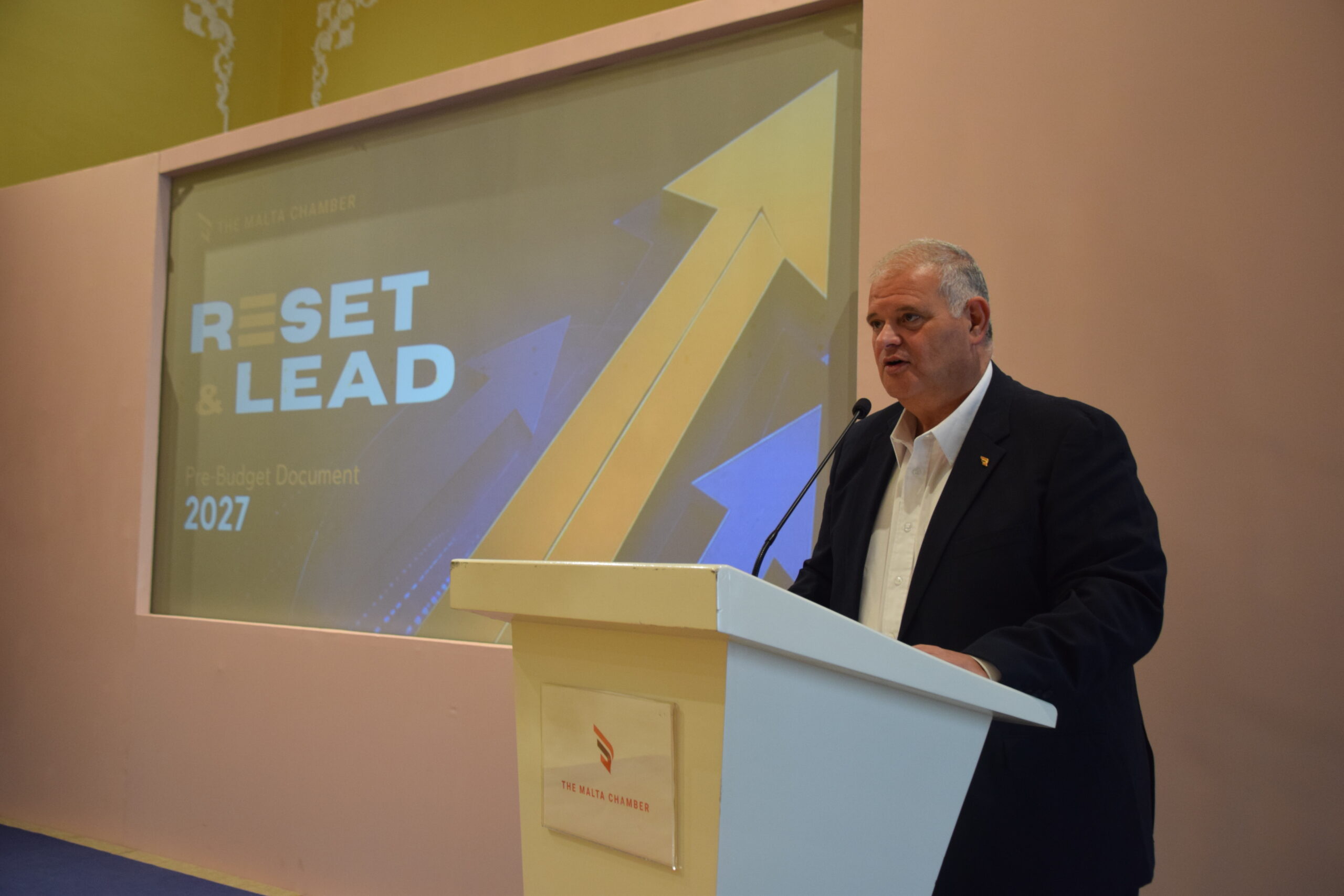
Malta needs to stop managing from crisis to crisis and start investing in resilience, President of the Malta Chamber of Commerce William Spiteri Bailey said.
He was speaking about Malta’s energy subsidies during the launch of the Chamber’s pre-budget document, titled: RESET and LEAD.
While underlining international geopolitical instability, he said that Government cannot control such issues, but it can control how the country confronts and prepares for them. Here, he brought up energy subsidies, reiterating that a complete subsidy on energy and fuel alone is not the long-term solution
“We understand why Government intervened to protect families and businesses. But we must also ask ourselves: what have we done during these years to reduce our exposure to the next crisis?”
He said that if even part of the sums spent on subsidies had been directed to renewable energy, energy efficiency, storage and incentives to invest in energy resilience, Malta would today be less exposed to international shocks.
Mr Spiteri Bailey said that while support is necessary when circumstances need it, such support must go hand-in-hand with a transition that makes it less dependant on that support in the future.
Referring to the title of the pre-budget document, the Chamber President said that Malta has reached a point where adjusting around the edges is no longer enough.
“We need to reset what is not working and have the courage to lead through the realities we face,” he said,
The Malta Chamber recognises that Malta has achieved considerable economic success, he said. “But we must also have the courage to say something equally important: Not everything is well.”
The Malta Chamber President said that the country’s infrastructure is under pressure, productivity remains weak, and that there is unnecessary bureaucracy.
He also said that the country’s energy dependence leaves it exposed, and that confidence in some institutions was damaged.
“Acknowledging these realities is not talking Malta down. Quite the opposite. However you cannot fix a problem that you are unwilling to admit exists. Sometimes, as a country, we simply need to call a spade a spade.”
Turning to the labour market, the Chamber President said that Malta must reduce dependency on importing more labour, but underlined that this does not contradict calls for more efficient work permit processing.
“But the reset Malta needs goes much deeper than economics. It must also be a reset in governance.”
He said that institutions must have the independence, resources, competence and courage to perform their functions without fear or favour.
The rule of law must mean the same thing for everybody, he continued, adding that when enforcement is weak or inconsistent, ethical businesses that follow the rules are penalised.
“That is bad for business and it is bad governance. Transparency must become automatic rather than something extracted from Government.”
He said that Malta is very good at producing strategies, reports, inquiries and recommendations, but its weakness is implementation.
“A strategy without execution is simply a document. And accountability without consequences is not accountability. This is why good governance cannot be separated from economic policy. Good governance is economic policy.”
He said that investors look at predictability, institutional stability, transparency and the rule of law.
“Trust has economic value. And the loss of trust has an economic cost.”
Featured image: Malta Chamber of Commerce
‘We want to build a group that will outlive us all’ – James Barbara
James Barbara brought a group of major businesses together under a new corporate identity.
LifeStar Insurance appoints economist Jean Paul Fabri as Interim Acting CEO
His appointment follows the departure of Jonathan Camilleri as CEO.

Building on Ferraracasa’s legacy: Third generation, next chapter
Joining an established family business brings a different challenge to building one from the ground up. The foundations already exist, ...
‘I dreamed of moving to Malta 20 years ago’: iQrypto CEO
Quantum tech firm iQrypto is set to expand its operations to Malta.
