


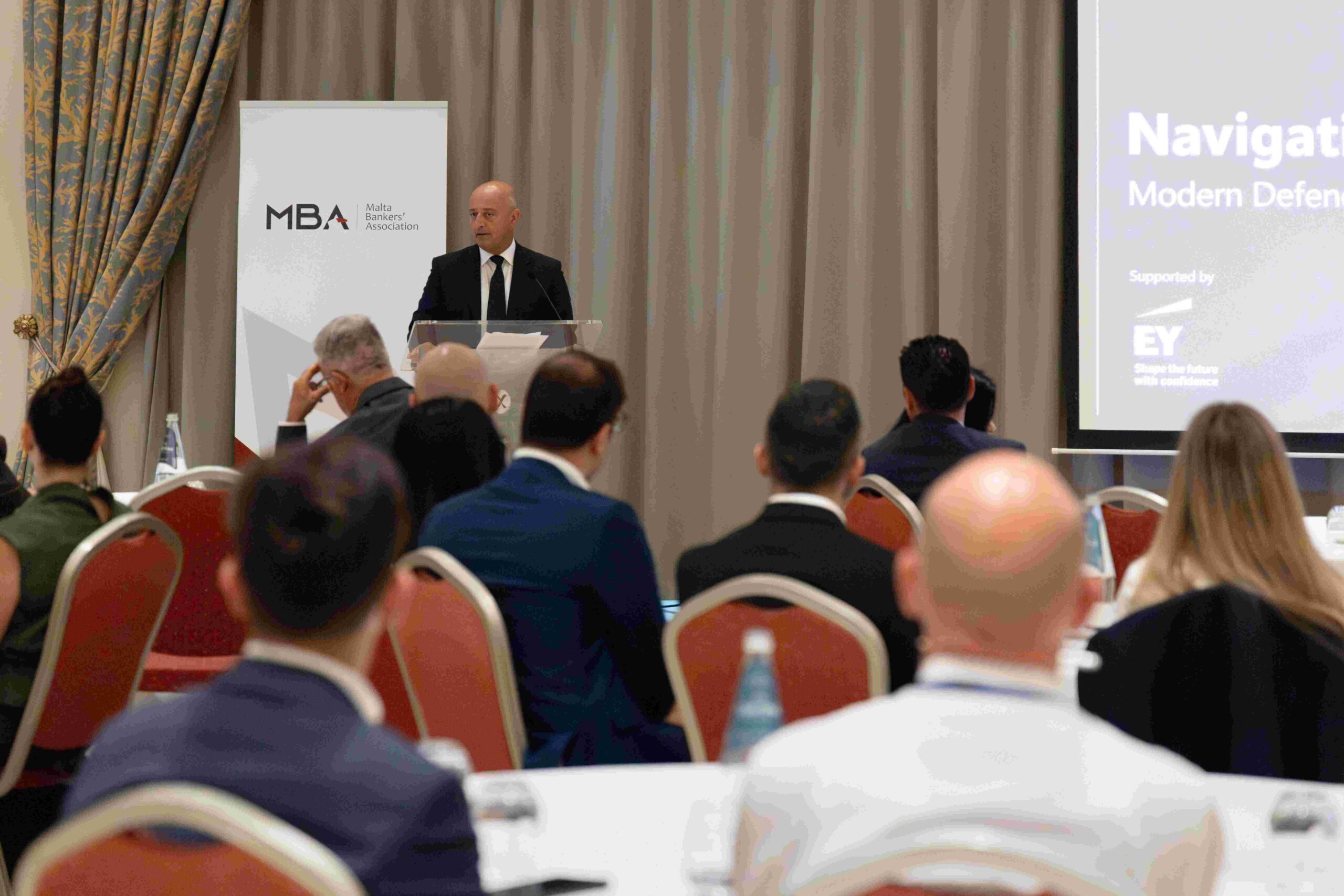
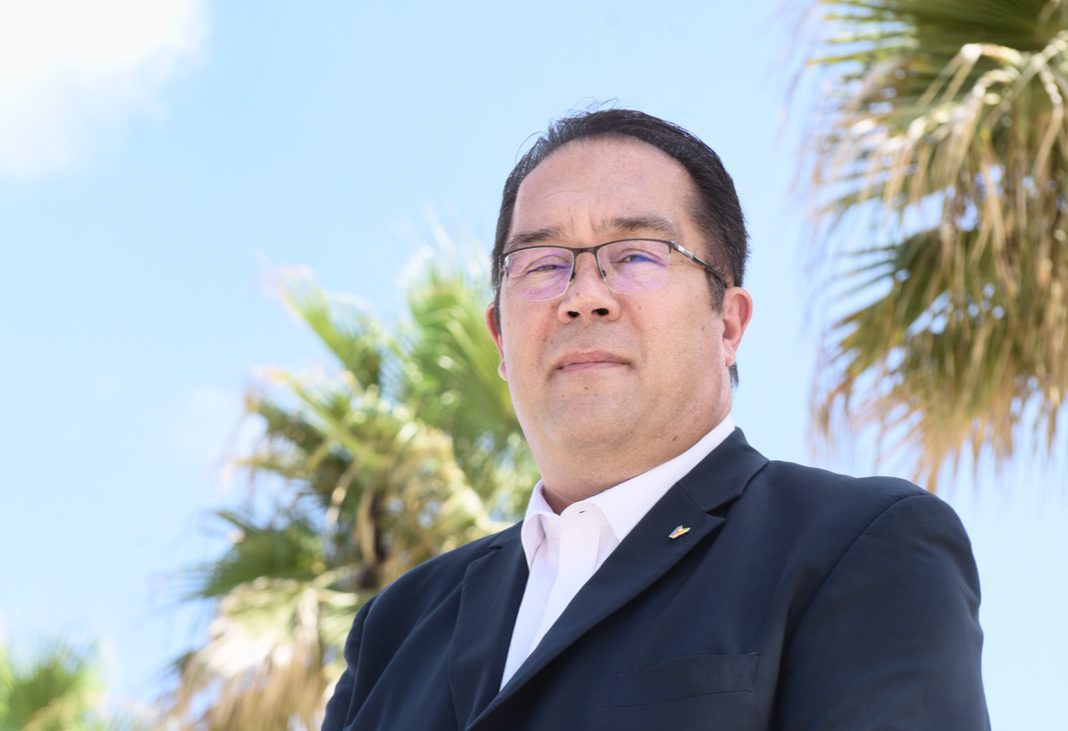
Malta Bankers’ Association (MBA) Chair Kenneth Farrugia has called for greater collaboration across Malta’s financial system as institutions contend with increasingly sophisticated financial crime, geopolitical uncertainty and technological change.
Speaking at a conference organised by the MBA in collaboration with EY Malta, Mr Farrugia argued that protecting individual organisations is no longer sufficient, given the broader implications financial crime can have for a jurisdiction.
“Our responsibility is not only to protect our respective organisations. Our responsibility extends itself to the national dimension,” he said.
The conference, held on 29th September under the theme Navigating Complexity: Modern Defences against Financial Crime, brought together representatives from the financial services sector to discuss emerging risks and the measures required to address them.
Mr Farrugia highlighted how significantly the financial crime landscape has changed over the past two decades.
What was previously a comparatively straightforward transaction-processing environment has developed into a more complex system involving advanced transaction-monitoring tools, expanding regulatory requirements and increasingly sophisticated forms of criminal activity.
Geopolitical tensions and the sanctions imposed in response to international conflicts have added another layer of complexity for banks and financial institutions.
Against this backdrop, Mr Farrugia stressed that institutions cannot tackle financial crime in isolation. He pointed to the need for cooperation between banks, other financial institutions, regulators, enforcement authorities and other stakeholders.
The conference also addressed the implications of artificial intelligence (AI) for the sector.
Cynthia Borg, Chair of the MBA's Financial, Cyber Crime & Fraud Standing Committee, identified regulatory transformation, geopolitical volatility and AI as some of the forces changing the responsibilities of financial crime compliance professionals.
She argued that the challenge facing professionals is increasingly not simply keeping pace with developments, but anticipating emerging threats.
Discussions throughout the event covered sanctions evasion, proliferation financing, anti-money laundering controls, human trafficking and the risks and opportunities associated with AI.
Participants also considered the changing European regulatory environment, including the role of the EU's Anti-Money Laundering Authority (AMLA) and the implementation of new anti-money laundering requirements.
Speakers included George Grech of GREX Strategies, Michael Stellini of Stellini Advisors, Ruth Dearnley from NGO Stop the Traffik, University of Malta academic Dr Dylan Seychell, Neil Micallef from the Malta Digital Innovation Authority and Manuel Delgado from EY Spain.
Representatives from the Financial Intelligence Analysis Unit (FIAU), Malta Financial Services Authority (MFSA) and MBA member banks also participated in panel discussions.
MBA Secretary General Karol Gabarretta echoed the call for collaboration in his closing remarks, arguing that financial crime prevention requires cooperation extending beyond the financial sector to regulators, enforcement authorities, technology specialists, academia and civil society.
“Our task now is to translate today’s insights into stronger cooperation, more effective application of controls and enhanced oversight, ultimately leading to greater protection for our institutions, our customers and society in general,” he said.


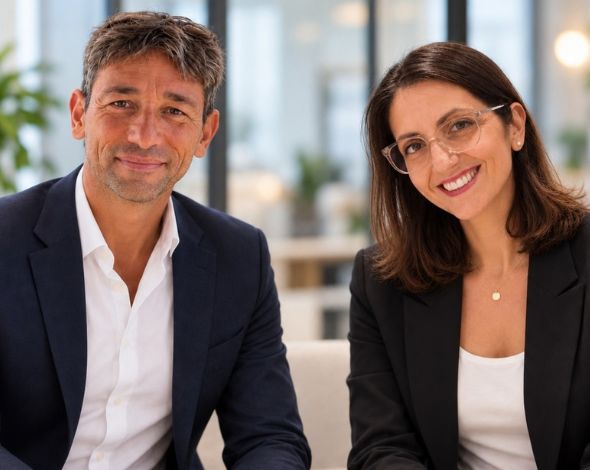
Nathan Farrugia and Mireille Muscat set up leadership peer network
'Leadership can become surprisingly isolating long before someone reaches the C-suite'.
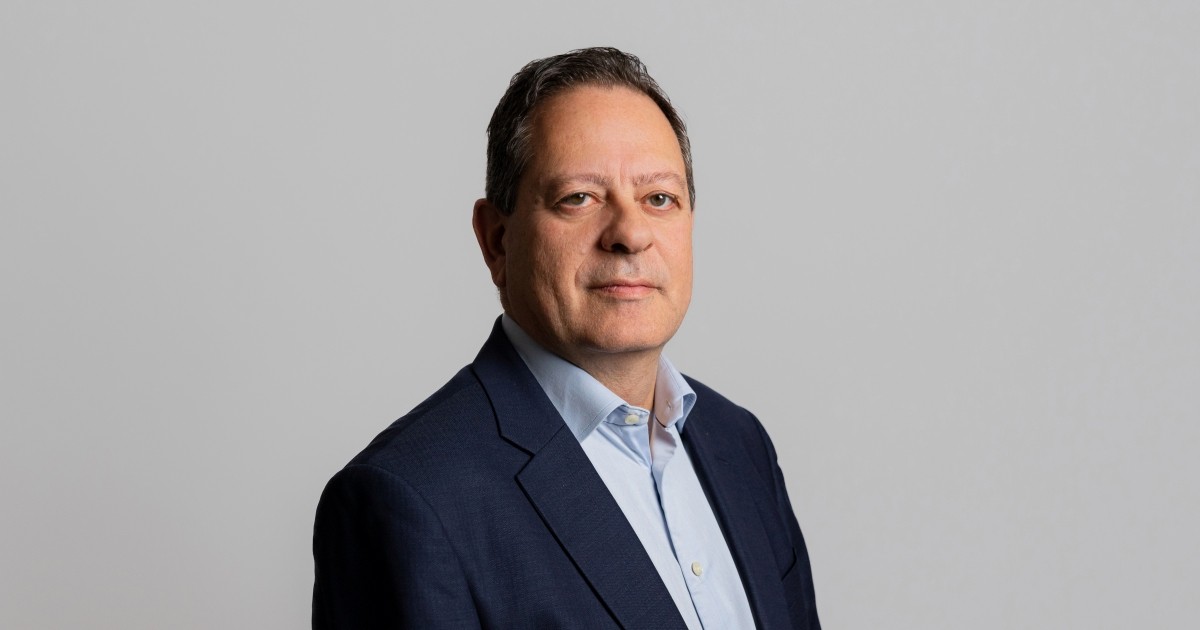
Corinthia CEO Simon Naudi: Hotel awards reflect teams’ ‘standards, efforts and creativity’
Corinthia hotels secured a series of accolades from Condé Nast Traveler and the Michelin Guide.
Global tourism summit an ‘extraordinary opportunity for Malta’ – MTA CEO
Over 200 of the world's leading travel & tourism CEOs are set to gather in Valletta.

Why smart leaders are learning to embrace workplace conflict
The challenge for today's leaders is not eliminating conflict but making sure it is handled constructively.
