


Malta’s labour market has never been more international. With 38.6 per cent of the workforce now made up of foreign workers, for many employers the real question is no longer about simply attracting them, but about keeping them. The Central Bank of Malta has released new research that paints the most comprehensive picture of the local situation to date.
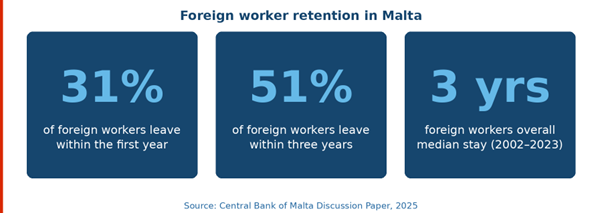
Around 31 per cent of foreign workers leave Malta within their first year, and roughly 51 per cent depart within three years. With the median length of stay being three years.
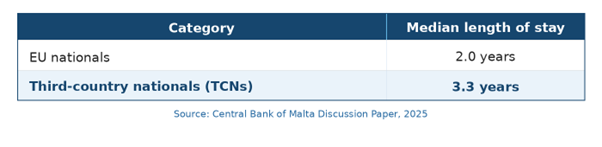
Third-country nationals (TCNs), workers from outside the EU, actually stay in Malta longer than their EU counterparts. The median stay for TCNs is 3.3 years, compared to just two years for EU nationals.
Notably, around 63 per cent of foreign nationals never change employers during their time in Malta. Once they settle in, the vast majority are not job-hopping. They stay with the same organisation that first hired them.
What is driving departure, and what can employers do about it?
The data suggests that 41 per cent of those who leave Malta, move to other EU countries rather than returning home, meaning the competition for this talent is pan-European, not just local.
The data also points to something employers can influence directly. Retention is not just about permit policy or administrative processes, but is shaped by the employment experience within a given business: how workers are treated, whether they see career progression, how well they are integrated into the organisation, and of course, whether their conditions reflect what is fair and competitive in the market.
Workers who come to Malta may initially accept terms that are an improvement on what they had at home. Over time, however, they become more aware of the standards that apply across Malta and Europe. If they notice a difference between their own conditions and what is available elsewhere both locally and outside our shores, they are less likely to stay. This is a rational decision, rather than a sign of disloyalty. It happens generally when an employer has not invested properly in their people.
The implication for employers is that they should treat TCN employees in the same way as all other employees, with a thorough onboarding process, effort put into integration, clear opportunities for progression, and conditions that are fair and competitive. This is not only the right thing to do, but it is the most commercially effective retention strategy available.
Sectoral differences in the turnover of foreign talent
The data becomes even more revealing when broken down by sector. Across Accommodation and Food Services, EU nationals stay a median of just 1.1 years. TCNs in the same sector stay for 3.4 years.
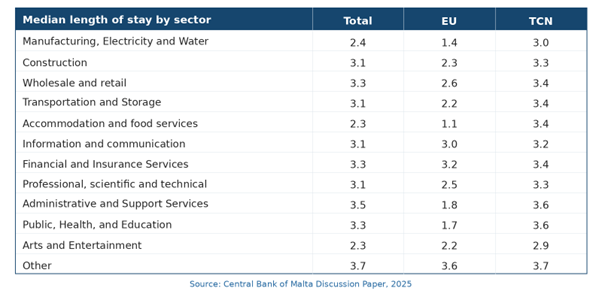
In high-turnover sectors such as accommodation and food services, manufacturing and transport, TCNs often outlast their EU counterparts. The sectors with high retention rates aren’t struggling with TCNs. They have a sector issue. Poor working conditions, shift patterns, and unclear career paths make it tough for any worker to settle down, no matter where they come from.
Introducing Konnekt’s Candidate Engagement Team
Retaining talent begins long before an employment contract is signed. Sourcing and hiring the right person, someone whose skills, expectations, and career goals align with what the organisation can genuinely offer, is foundational. A mismatch at the point of recruitment is difficult to recover from.
This is where specialist expertise creates measurable value. Konnekt’s Candidate Engagement Team focuses specifically on recruiting for blue collar roles, bringing process knowledge and access to a talent pool of foreign candidates who already reside in Malta.
Konnekt helps employers to move efficiently through the recruitment process without compromising on finding the right fit. The goal is not just to fill a vacancy. It is to find the right person and support the conditions under which that person is most likely to stay and contribute.
Get in touch at konnekt.com to help you with your hiring needs.
About the research
This article draws on a discussion paper published by the Central Bank of Malta in 2025, using data spanning 2002 to 2023. Our thanks to the researchers, particularly Ian Borg, for this valuable contribution to the evidence base.
Read the full paper here.




International Women’s Day: Change the system, not the slogans
'International Women’s Day is not just a celebration of how far we have come, but also reminder of how much ...

What survives February matters more than what starts in January
How many goals or resolutions did you set in January?

Human-first leadership means backing personal goals, not just performance targets
Supporting personal ambitions outside work is not a soft perk, but a strategic advantage.

Global CEO confidence hits five-year low as AI returns lag – but Maltese leaders signal resilience
The question is whether Malta’s resilience today could mask the need for faster transformation tomorrow.
