


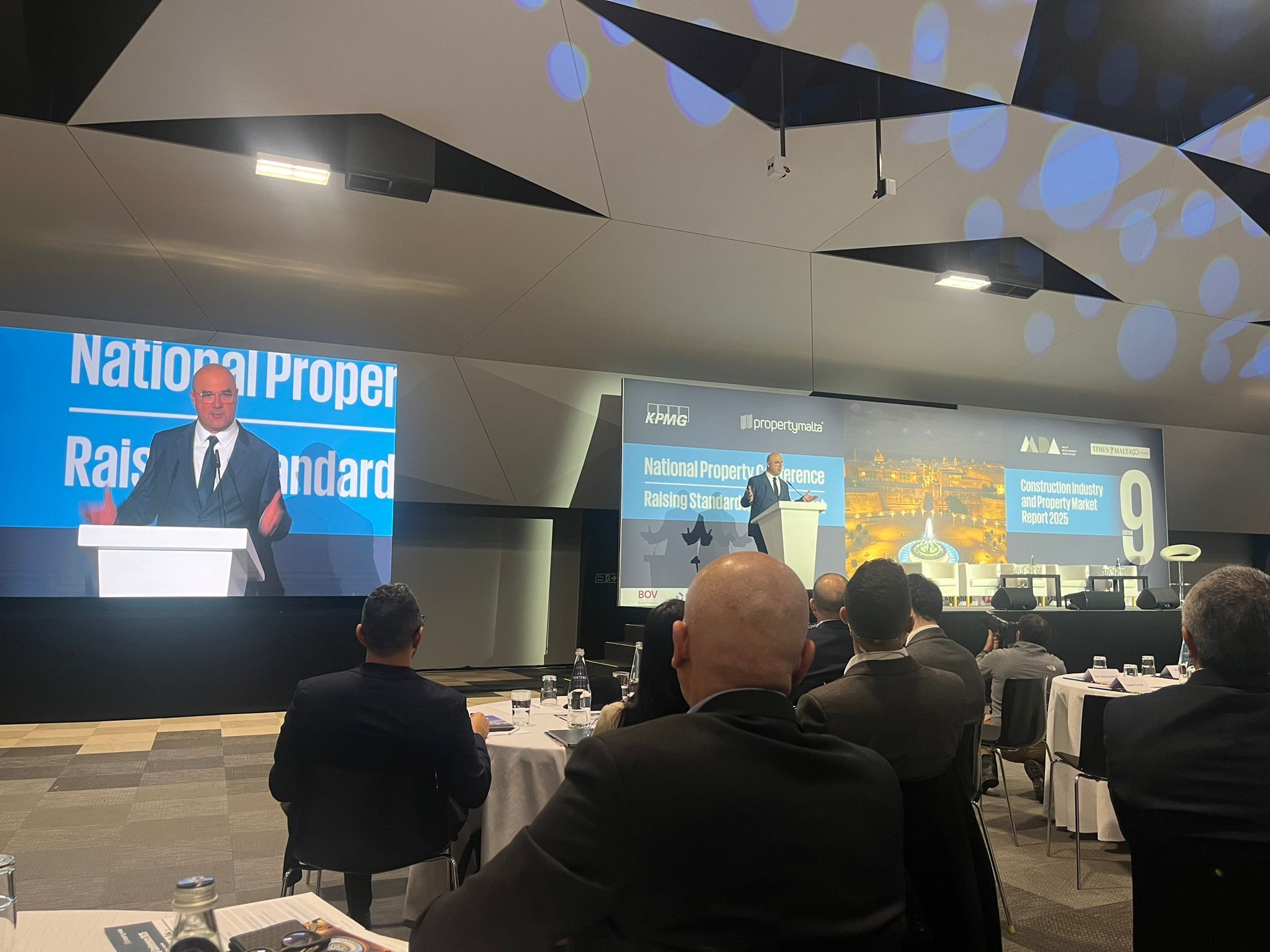
A powerful plea for collaboration from Property Malta CEO Sandro Chetcuti resonated at the National Property Conference on Tuesday (today), as he urged stakeholders to move beyond divisive rhetoric.
“Let’s not throw rocks at each other. Let’s sit, talk and make sure everyone wins,” he stated, setting a definitive tone for the event.
This call for unity framed the conference, organised by Property Malta and KPMG, which brought together the industry’s leading figures to navigate the complexities of a robust market. While celebrating the sector’s massive economic contributions, the dialogue consistently returned to a pressing need for higher standards, greater trust, and a more collaborative path forward, with key addresses from Mr Chetcuti and Prime Minister Robert Abela.
The economic backbone
The conference was grounded in hard data, with a report published by KPMG titled ‘Construction Industry and Property Market in 2025’ providing the quantitative foundation.
The figures were undeniably significant: The construction industry and real estate activities are colossal economic drivers, contributing a combined €3.94 billion in value added to the Maltese economy when considering direct, indirect, and induced impacts.
Directly, the sector accounts for 9 percent of Malta’s Gross Value Added (GVA), a figure that rises to 14 percent when indirect effects are included. This translates to roughly €14 of every €100 generated in the economy being linked to property and construction.
The industry employs approximately 40,000 people, underscoring its role as a major employer. KPMG’s market soundbite for 2025 painted a picture of a “resilient and stable” sector with steady growth in residential deeds and permits. However, it also highlighted the dual nature of the market: Rising property prices are “positive news for existing owners and investors, but more challenging for those striving to enter the market. “Notably, the commercial rental market is expected to see a decline in 2025, correcting a previous supply glut.
Mr Chetcuti’s plea: Raising standards and building trust
Sandro Chetcuti did not shy away from the industry’s reputational challenges. He directly addressed the need for a qualitative leap, stating, “There is a need to not only see better development re design but infrastructure. Investment better. Planning better. More democracy.
“His most powerful remarks centred on the toxic nature of current debates. “How did the industry become so toxic?” he asked, noting that when an industry is worth €3 billion, “everyone is in property.”
He called for a move away from destructive criticism towards constructive dialogue. “Unfortunately, everyone notes that there isn’t enough trust… we need more togetherness over partisanship. Let’s not throw rocks at each other. Let’s sit, talk and make sure everyone wins.”
Dr Abela’s deference
Prime Minister Robert Abela offered a staunch defence of the government’s handling of the sector, recalling the “national panic” of the COVID-19 pandemic in 2020 when the government controversially lowered taxes to stimulate the market – a move he said many thought was “crazy” at the time.
He firmly stated that while design and quality can be improved, the government “will never be in a place where we hinder people’s rights and interests in this industry.”
Citing a homeownership rate that has risen from 81 percent to 88 percent during his tenure, he pushed back against what he called “disinformation,” asserting that it is “not true that young people are leaving.” He pointed to Eurostat data showing wage growth and low inflation as evidence of a “dynamic and strong” economy.
The conference highlighted the central dichotomy of Malta’s property sector: Its undeniable economic power versus the societal and environmental costs associated with its growth. The consensus among speakers was that the industry is too big to ignore or to fail, but that its future success hinges on a more mature and collaborative approach.
The challenge, was duly outlined by both Mr Chetcuti’s call for trust and Dr Abela’s aversion to “shock decisions,” is to forge a path that sustains economic momentum while decisively addressing the critical issues of quality, affordability, and environmental responsibility.
Adrian Galea responds to EU Inc. criticism, argues proposal could unlock growth for Malta
He believes it could represent a 'step function improvement' for Europe’s startup ecosystem.
KM Malta ‘not insulated from market volatility,’ says Executive Chairman
David Curmi nonetheless stressed that the airline has measures in place to manage the risk responsibly.
Joseph Mifsud Grima named to Captive Review’s 2026 Forty Under 40 list
'I am incredibly honoured.'
Aġenzija Sapport CEO: ‘People underestimate what someone with a disability can bring to the table’
'Subtle double-takes, lowered expectations, and quiet assumptions.'
