


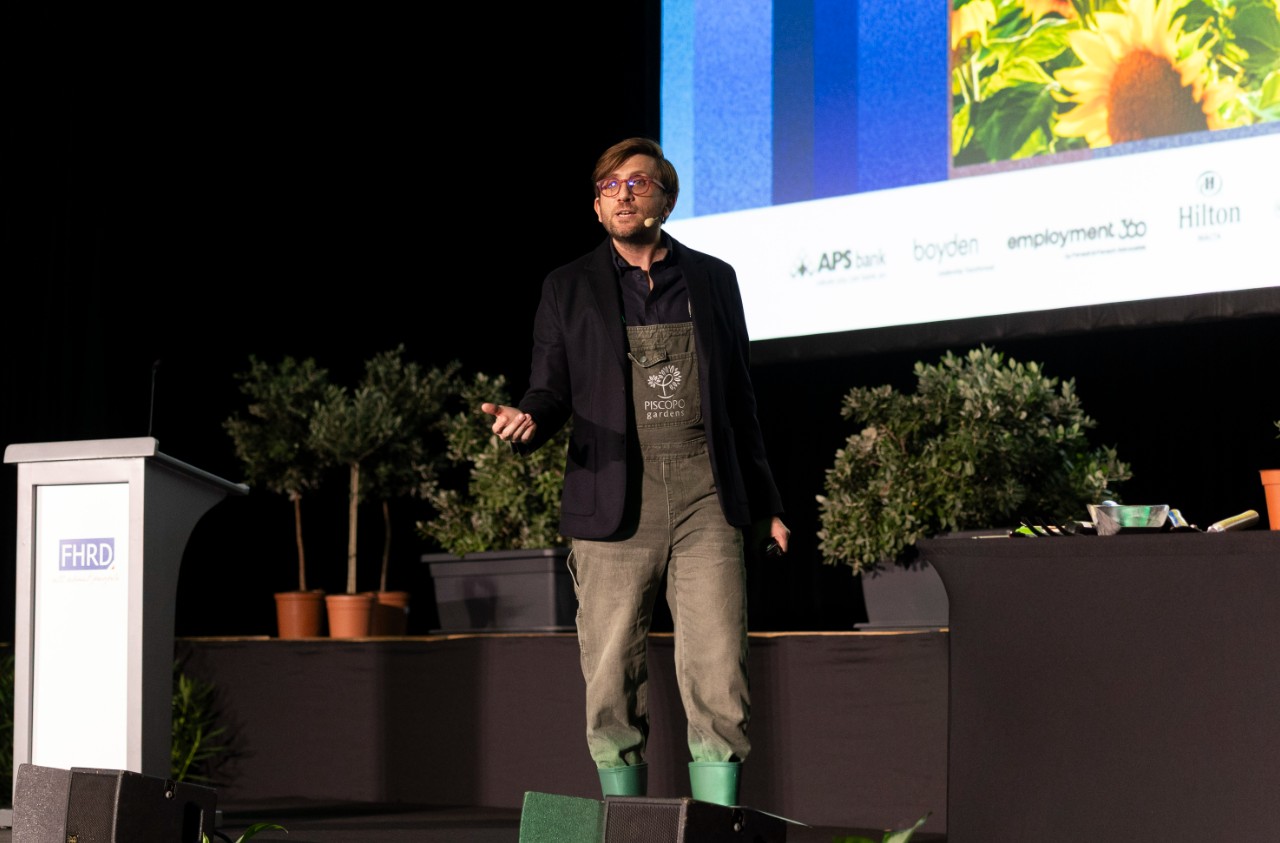
Imagine sitting at a national HR conference, waiting for the next speaker to walk on stage – and instead, a man dressed as a gardener steps out, surrounded by plants, tools, and a makeshift garden scene.
That’s exactly what happened at this year’s FHRD conference, where Leadership Development specialist Alex Falzon delivered what he believes to be Malta’s first fully transformed keynote of its kind.
Far from a gimmick, the gardener costume and garden-themed stage design were part of a deliberate strategy to challenge HR leaders to think differently – radically differently – about how they manage talent.
Mr Falzon told MaltaCEOs.mt that the bold approach stemmed from a simple question: How can HR professionals be encouraged to break old patterns if speakers keep using the same formats?
Instead of a classic corporate presentation, he decided to embody the message he wanted to convey.
“Last month, I became what I believe is the first keynote speaker in Malta to completely transform both myself and the stage for a professional conference. Instead of the typical corporate presentation at the FHRD conference, I decided to be 'mad' enough to do something that's never been done locally – dress up as a gardener and transform the Hilton conference stage into a garden setting.”
The session – which has since surpassed 10,000 impressions online – centred around a leadership philosophy Mr Falzon calls “Cultivate or Crumble”.
Introducing the CGO: Chief Gardening Officer
At the heart of the keynote was a provocative idea: HR leaders should stop focusing solely on recruitment, and instead cultivate “multiplier leaders” within their organisations.
He introduced the concept of the Chief Gardening Officer (CGO) – a metaphorical role that encourages leaders to treat talent like a garden that needs nurturing, rather than a resource to be constantly replaced.
The CGO framework is built around three pillars:
- C – Catch multiplier potential in current teams
- G – Grow multiplier behaviours in managers
- O – Optimise systems that multiply multipliers across the organisation
This approach, he argues, is essential at a time when businesses face increasingly tight labour markets and rising competition for talent.
“Every organisation faces the same challenge,” he wrote on LinkedIn. “The lack of human resources to supply economic growth. But the solution isn't just hiring more people. It's cultivating the capability you already have.”
Why dress as a gardener? To prove a point
Mr Falzon says he could not ask an audience to be bold if he wasn’t willing to do the same.
“I chose this unprecedented approach because I wanted to embody the message I was delivering. If I was asking HR professionals to have the courage to do things differently and stop following the same old patterns, I needed to demonstrate that courage myself.”
His philosophy is clear: Leaders should aim for impact, not universal approval.
“When you break away from the norm, it will be liked by some and less by others, that’s part of the game. But either way, it leaves an impact. Most speakers aim to be liked by everyone and end up being forgotten by everyone. I chose meaningful impact over universal approval.”
And the idea seems to resonate. According to research he shared during the keynote, multiplier leaders can get 1.97 times more from their teams – almost double the output – without hiring anyone new.
The 8-month journey behind 25 minutes
What appeared on stage as a seamless 25-minute experience took eight months of preparation, 36 iterations of the keynote, and the involvement of nine key collaborators.
Mr Falzon credits a long list of people who helped bring his garden-themed vision to life: from the FHRD team, to designers, sponsors, and even Piscopo Gardens, who supplied the plants, tools, and gardening props.
In his own words: “Most of the initial work was convincing myself I had enough valuable content for this fantastic audience. Once I put my heart at rest it was of good value (imposter syndrome at its max), then I started getting feedback that it’s too much, so shaved the words by half.”
The work included a custom CGO quiz shared live during the keynote – a way for participants to evaluate their own “gardening” abilities as leaders.
Mr Falzon summarises the core of his message simply: “Sometimes you need to be mad enough to do something that’s never been done locally to create meaningful change.”
As he told the audience in his closing challenge: Will you cultivate – or will you crumble?


Two masterpieces, one remarkable instrument
Michael Pantalleresco explores the poetry, passion and brilliance of the clarinet in works by Mozart and Weber.
‘A setting we couldn’t be prouder of’: db CEO on Hard Rock Hotel’s new rooftop restaurant
Cyana’s head chef is Spiros Tzilis, a Greek chef who has worked at Michelin-starred restaurants.

‘AI might be faster and cheaper, but at what cost?’ – Aramis Capital MD
He warns that businesses risk sacrificing service quality, human judgement and accountability in their pursuit of greater efficiency through artificial ...

‘We’re already late’: Employers chief calls for cross-party mass transport agreement
Through cross-party agreement, the solution will endure beyond individual legislatures, he explains.
