



Business jets registered in Malta are operating across a far broader global footprint than many might expect, according to new analysis penned by Kurt Sant, who is a Central Bank Economist and Technical Attaché for Maritime and Aviation Affairs at Malta’s Permanent Representation to the European Union.
The data, drawn from nearly 804,000 flights carried out by Maltese-flagged aircraft in 2024, provides one of the clearest pictures yet of how private and corporate aviation is using the 9H register.
While civil passenger aircraft dominate total activity, business jets represent a significant and distinctive component of the registry, with 58,920 business jet flights recorded during the year. Their operations reveal clear patterns in long-range mobility, transatlantic usage, and premium charter demand.
The report’s dataset shows that business jets under the Maltese flag are active across Europe, North America, Asia, the Middle East, and parts of Africa, forming a network that is far more globalised than commercial short-haul fleets.
Most business jet flights remain Europe-centred. The analysis highlights strong activity across Western and Central Europe, with dense patterns in France, the UK, Italy, Germany, Switzerland, the Netherlands, and Spain – routes typically associated with corporate travel, high-net-worth mobility, and charter operations.
But business jet traffic is also notable for the extent of intercontinental operations, including:
- Transatlantic routes connecting Europe with the United States and the Caribbean
- Substantial intra-North American flying, particularly for VistaJet’s fleet
- Activity in Asia, including Japan, China, Singapore and India
This contrasts with commercial fleets, where activity is heavily concentrated within Europe.
Operator-specific patterns reveal distinct business models
The report examines the most-flown business jet of several leading Malta-registered operators, showing how each uses the registry for different market segments.
VistaJet’s 9H-VCC shows a wide geographical spread, covering Europe, North America, the Caribbean, and significant parts of Asia. The operator’s model – high-end, long-range charter and subscription services – is reflected in its intercontinental routes.
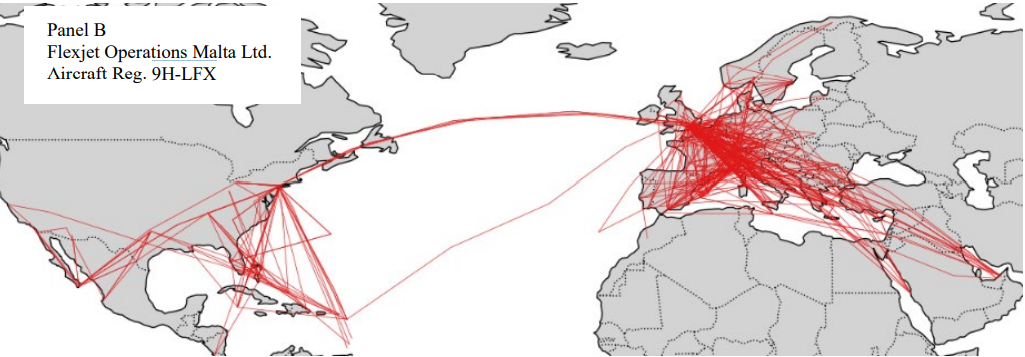
Flexjet’s 9H-LFX maintains strong presence across Europe but also undertakes US and Caribbean flying, indicating dual-market operations aligned with its fractional ownership structure.
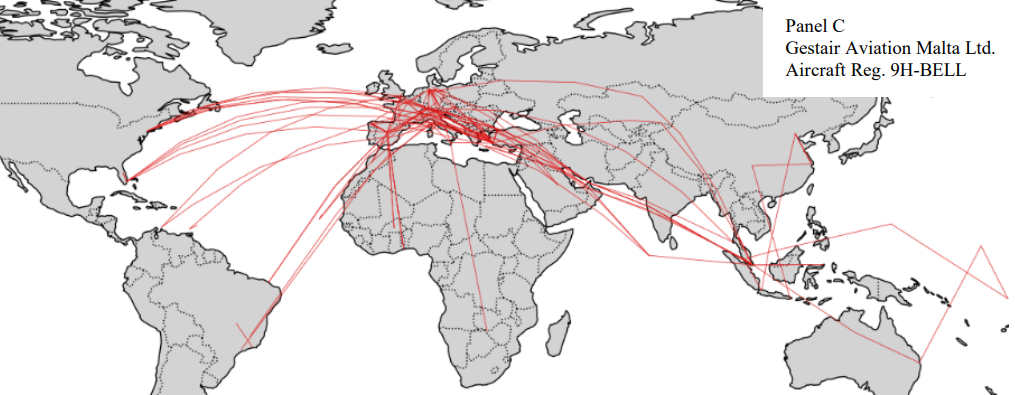
Gestair’s 9H-BELL operates across Europe, North and South America, Asia, and Australia/Oceania. Among the operators analysed, it is the most broadly dispersed geographically, underscoring its focus on bespoke long-range charter missions.
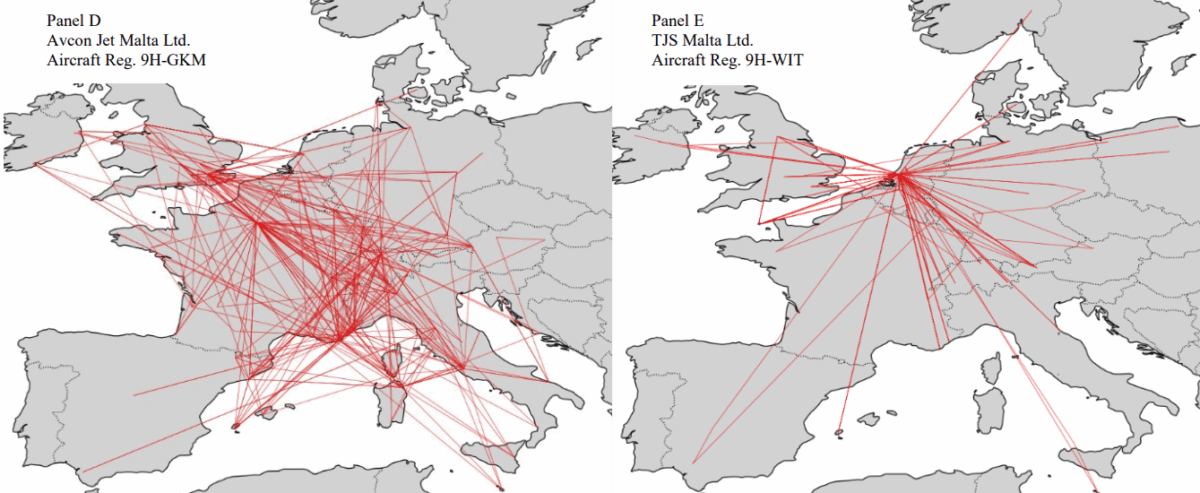
Avcon Jet Malta and TJS Malta – predominantly intra-European
These operators maintain almost entirely Europe-based networks, with routes aligned to short- and medium-haul charter demand. Avcon Jet’s 9H-GKM and TJS Malta’s 9H-WIT operate almost exclusively within Europe.
Together, these examples reflect the diversity of the sector: From pan-European charters to intercontinental executive travel.
Aviation infrastructure enabling global private operations
The report attributes Malta’s attractiveness for business jet registration to several structural factors:
- Regulatory stability under EASA and ICAO
- Streamlined registration processes
- Access to the European Single Aviation Market
- A growing cluster of MRO, training and aircraft management services
The presence of large operators such as VistaJet, Flexjet, AirX Charter, Gestair, Avcon Jet, and TJS Malta indicates that Malta has become a preferred jurisdiction for long-range and premium aviation companies seeking EU operational rights and a predictable regulatory environment.
Long-range flying and its environmental weight
Although business jets account for only 7 per cent of total Maltese-flagged flights, they contribute 476 million kilograms of CO₂ emissions, according to the report’s carbon estimates.
The environmental analysis highlights that while their total emissions are lower than commercial fleets due to smaller flight numbers, per-passenger emissions are significantly higher, especially on long-range or low-occupancy missions.
The deployment of Malta-registered business jets reflects a mix of Europe-centred corporate travel and increasingly globalised long-range demand. Operators such as VistaJet, Flexjet, and Gestair are using the Maltese register to support complex, multi-continent operations, positioning Malta as a jurisdiction of choice for premium aviation.
As the private aviation segment continues to expand within the 9H register, its role in Malta’s wider aviation strategy – and its regulatory and environmental implications – is likely to attract increasing policy attention.
Featured Image:
Pexels




‘Our opening scenes looked like the first Rocky film’ – Dennis Mark Gauci on CLA Malta’s success
It was a small team, with long days and big ambition

Buddha-Bar lands in Malta
The world-renowned brand opens in St Julian's on 29th October.

Kenneth Farrugia: Financial crime prevention ‘extends to the national dimension’
He argues that protecting individual organisations is no longer sufficient, given the broader implications financial crime can have for a ...

Nathan Farrugia and Mireille Muscat set up leadership peer network
'Leadership can become surprisingly isolating long before someone reaches the C-suite'.
